
For UK Healthcare Professionals Only
Solifenacin Succinate 1mg/ml Oral Solution
Keep Incontinence In-check
in overactive bladder syndrome
A ready-to-use once daily oral solution for adults with symptoms of overactive
bladder syndrome.
For the symptomatic treatment of urge incontinence and/or increased urinary frequency and urgency in adults, including the elderly, with overactive bladder syndrome.

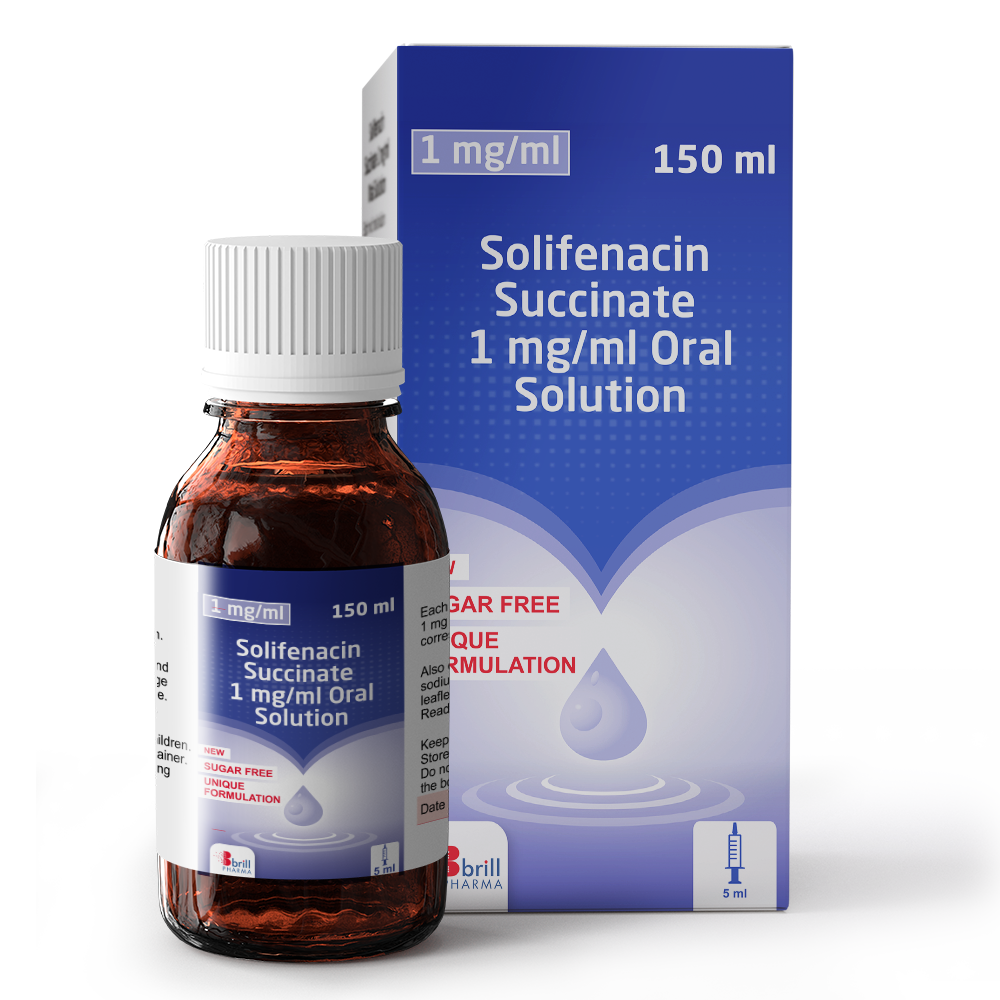
| Strength | 1mg/ ml |
| Pack Size | 150 ml |
| Measuring Device | 5 ml oral syringe with adaptor (graduated at every 0.5ml equivalent to 0.5 mg) |
| Regulatory Status | POM |
| Flavour | Peppermint |
| Suitable for Vegetarians | Yes |
| GTIN | 5060712420027 |
| PIP code | 1243732 |
Special Populations
Consult the Summary of Product Characteristics for full details
Paediatric populations
The safety and efficacy of solifenacin succinate oral solution in children and adolescents have not yet been established. Solifenacin succinate should not be used in children and adolescents aged under 18 years of age.
Elderly
No dosage adjustment is required.
Patients with renal impairment
No dose adjustment is necessary for patients with mild to moderate renal impairment (creatinine clearance > 30 ml/min).
Patients with severe renal impairment (creatinine clearance ≤30 ml/min) should be treated with caution and receive no more than 5mg (5ml) once daily (see Section 5.2 SmPC).
Solifenacin succinate is contraindicated in patients with severe renal impairment treated with a potent CYP3A4 inhibitor.
Patients with hepatic impairment
No dose adjustment is necessary for patients with mild hepatic impairment. Patients with moderate hepatic impairment (Child-Pugh score of 7 to 9) should be treated with caution and receive no more than 5mg (5ml) once daily (see Section 5.2 SmPC).
Solifenacin succinate is contraindicated in patients with severe hepatic impairment or moderate hepatic impairment who are on treatment with a potent CYP3A4 inhibitor.
Patients either planning a pregnancy or pregnant; breast-feeding patients
It’s preferable to avoid solifenacin succinate in patients planning pregnancy. Safety during pregnancy is not established so exercise caution. Solifenacin succinate should be avoided during breast-feeding.

Contraindications
Solifenacin succinate is contraindicated in patients with urinary retention, severe gastro-intestinal condition (including toxic megacolon), myasthenia gravis or narrow-angle glaucoma and in patients at risk for these conditions.
Solifenacin succinate is also contraindicated for:
- Patients hypersensitive to the active substance or to any of the excipients (see Section 6.1 SmPC)
- Patients undergoing haemodialysis (see 5.2 SmPC)
- Patients with severe hepatic impairment (see 5.2 SmPC)
- Patients with severe renal impairment or moderate hepatic impairment and who are on treatment with a potent CYP3A4 inhibitor, e.g. ketoconazole (see 4.5 SmPC)
How to report adverse events
Adverse events should be reported.
Reporting forms and information can be found at: https://yellowcard.mhra.gov.uk.
Adverse events should also be reported to Brill Pharma Ltd
Tel: 0044 (0) 1582 545505 Email: info@brillpharma.co.uk
or
write to us: Brill Pharma Ltd, 6 Sovereign Park, Laporte Way,
Luton, Beds, LU4 8EL, UK
Have a question?
If you have a question about Brill Pharma or any products in our range please get in touch
Tel: 0044 (0) 1582 545505 Email: info@brillpharma.co.uk
This website and its contents are intended to provide information for a UK based healthcare professional audience only.
Date of preparation: December 2020 BLL-002-011